The Marin Insurance Ladder That's Quietly Repricing Comparable Homes
July 23, 2026
July 23, 2026
Two Marin listings can carry the same asking price, the same square footage, and the same school lookup, and still cost their next owners tens of thousands of dollars apart every year. The variable isn't the mortgage. It's which rung of California's insurance ladder each parcel lands on before escrow closes.
For a buyer comparing Mill Valley to Novato, or a Ross Valley cottage to a San Rafael flat, the median sale price is now a partial answer. Over the three months ending May 2026, Marin County homes sold at a median of about $1.6M, with the median price per square foot near $854 according to Redfin's county summary. That number tells you what homes trade for. It tells you nothing about what it costs to keep one insured, and in 2026 that gap is where deals are being won and lost.
California underwriting for a Marin single-family home now runs down a ladder with three practical rungs.
Where a Marin parcel lands on this ladder is not a matter of buyer preference. It's the output of CAL FIRE's zone classification, the insurer's brush score, defensible space compliance, and roof and vent construction. In the highest-risk ZIP codes statewide, roughly 41% of homes were on the FAIR Plan as of March 2026, versus about 4% in lower-risk areas.
Marin is not uniform. About one in fifteen Marin homes, roughly 7,000 properties, sit in areas the state classifies as Very High Fire Hazard Severity, according to reporting compiled by United Policyholders. Many more sit inside the wildland-urban interface without carrying the Very High label. Two houses on the same street can land on different rungs.
Consider two Marin listings a buyer might put side by side this summer. Both list at $1.6M. Both are three-bed, two-bath, roughly 1,800 square feet. On the portals they look interchangeable.
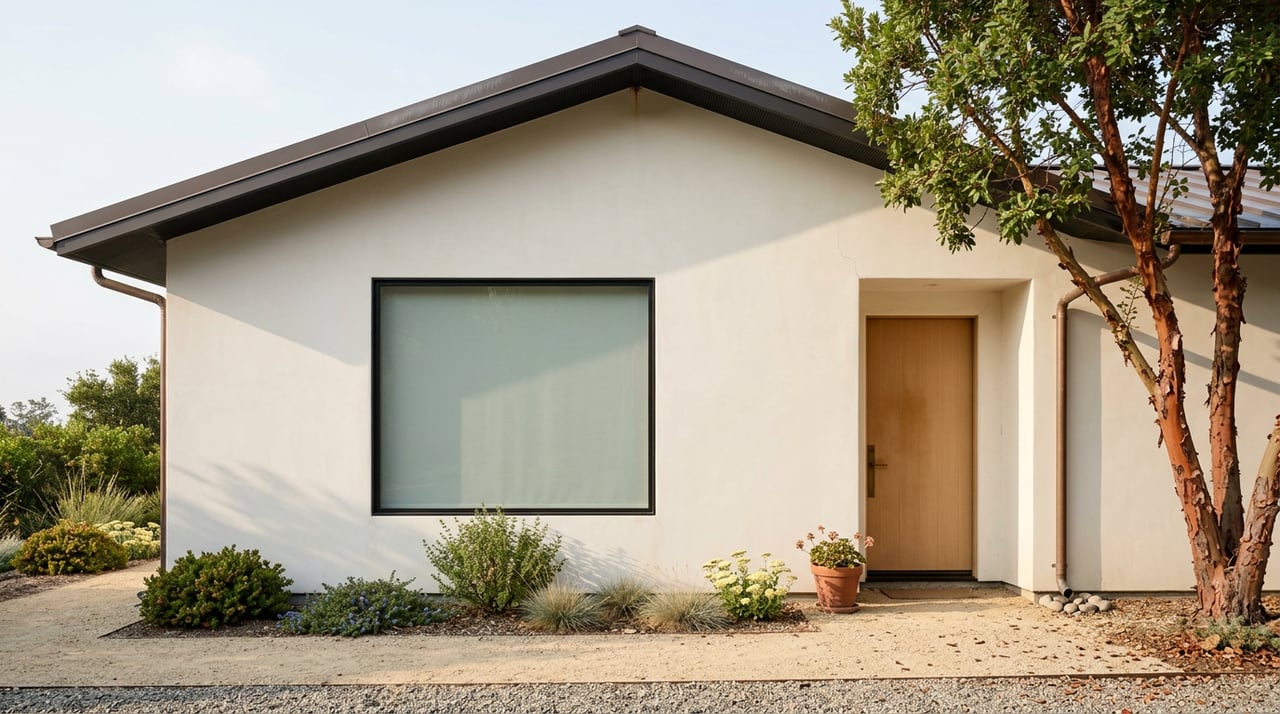
House A is in a Moderate zone with a Class A roof, ember-resistant vents, and a clean five-foot Zone 0 around the structure. An admitted carrier writes it at something close to the statewide average admitted HO-3 premium, around $1,480 a year based on the September 2025 admitted-market benchmark cited in Latent Insurance's FAIR Plan cost guide.
House B sits a mile away, uphill against open space, in a Very High Fire Hazard Severity Zone with a wood-shake roof and heavy vegetation inside twenty feet. No admitted carrier will write it. E&S declines because the brush score is out of appetite. The buyer ends up on a FAIR Plan fire-only policy paired with a DIC wrap. Latent's 2026 breakdown puts a $1M dwelling in a foothill county at $5,000 to $9,000 a year on the FAIR Plan alone, with the DIC wrap typically running another 25% to 60% of that FAIR Plan premium.
That's the same $1.6M sticker, and a plausible $6,000 to $10,000 annual difference in true cost of ownership. Over a seven-year hold, the delta funds a kitchen remodel.
Two forces will widen that gap through 2026. The FAIR Plan filed a 35.8% average rate increase in October 2025, pending California Department of Insurance approval for an April 2026 effective date, with about half of policyholders projected to see 40% to 55% increases and some tails much higher under the risk-based revisions. And a June 2026 Stanford Center on Energy Policy and Finance paper found average California homeowners premiums rose 84% between the end of 2020 and March 2026, with average deductibles climbing from $1,813 to $2,553, as summarized in Stanford Report.
Three regulatory moves are worth knowing before you write an offer in Marin.
The practical read for a buyer: a house currently on the FAIR Plan is not necessarily stuck there. If the seller can document Safer from Wildfires measures, or if there's a credible path to add them, an E&S or admitted quote may be reachable inside the first year of ownership. That optionality has value. Ask for it in writing.
Before removing the property inspection contingency, work through this in order:
None of these steps require the seller's cooperation to complete. Several can be finished in an afternoon.
Marin's June 2026 market read from local brokerage reporting shows closed sales up about 11% year over year, inventory down about 21.6%, and homes selling near 102% of original list price on average. Buyers have largely made peace with mortgage rates in the mid-6% range. Demand is real, and it is selective.
That selectivity is the tell. Move-in-ready homes in walkable, well-served pockets draw multiple offers. Homes needing work sit. Part of "needing work" now includes insurance work: the wood-shake roof, the juniper hedge inside the five-foot zone, the vent screens that don't meet ember-resistant spec. Those items used to be aesthetic. In 2026 they set the rung.
For the buyer, that means two things. First, the median is not your price signal. The price plus the ten-year insurance path is. Second, the homes that look overpriced because they're already hardened may be the ones actually priced correctly, once you finish the math.
Does a FAIR Plan policy at closing kill the deal? Not on its own. Most Marin lenders will accept FAIR Plan plus a bound DIC wrap. What kills deals is discovering at day 14 that the wrap quote is unavailable or the combined premium breaks the debt-to-income ratio.
Can I move a house from the FAIR Plan to an admitted carrier after I own it? Sometimes, and the tools for doing so improved in late 2025 and 2026. Documenting Safer from Wildfires measures, replacing a non-Class-A roof, and clearing Zone 0 are the levers. There is no guarantee, and it is not a same-week process.
Is a Very High Fire Hazard Severity Zone classification a reason not to buy? It's a reason to underwrite the ownership cost fully, not a reason to walk. Some of Marin's most desirable pockets are in higher-risk zones. The question is whether the total picture, including a realistic insurance path, still works for your budget and hold horizon.
Where do I find the zone map? Search "CAL FIRE Fire Hazard Severity Zone viewer." The state map is the reference insurers use, not the private wildfire scores you see on listing portals.
The Marin market rewards buyers who do this math before they fall for a house, not after. If you're comparing properties this summer and want a calm read on how the insurance ladder changes the true cost picture on the specific homes you're considering, Rob Sullivan is happy to walk through them with you. Let's connect.
If you are seeking a real estate professional whom you can trust and count on for the long haul, then look no further. Rob will earn your loyalty and turn your dreams into reality.